

Utility Workforce Development and Safety Culture:
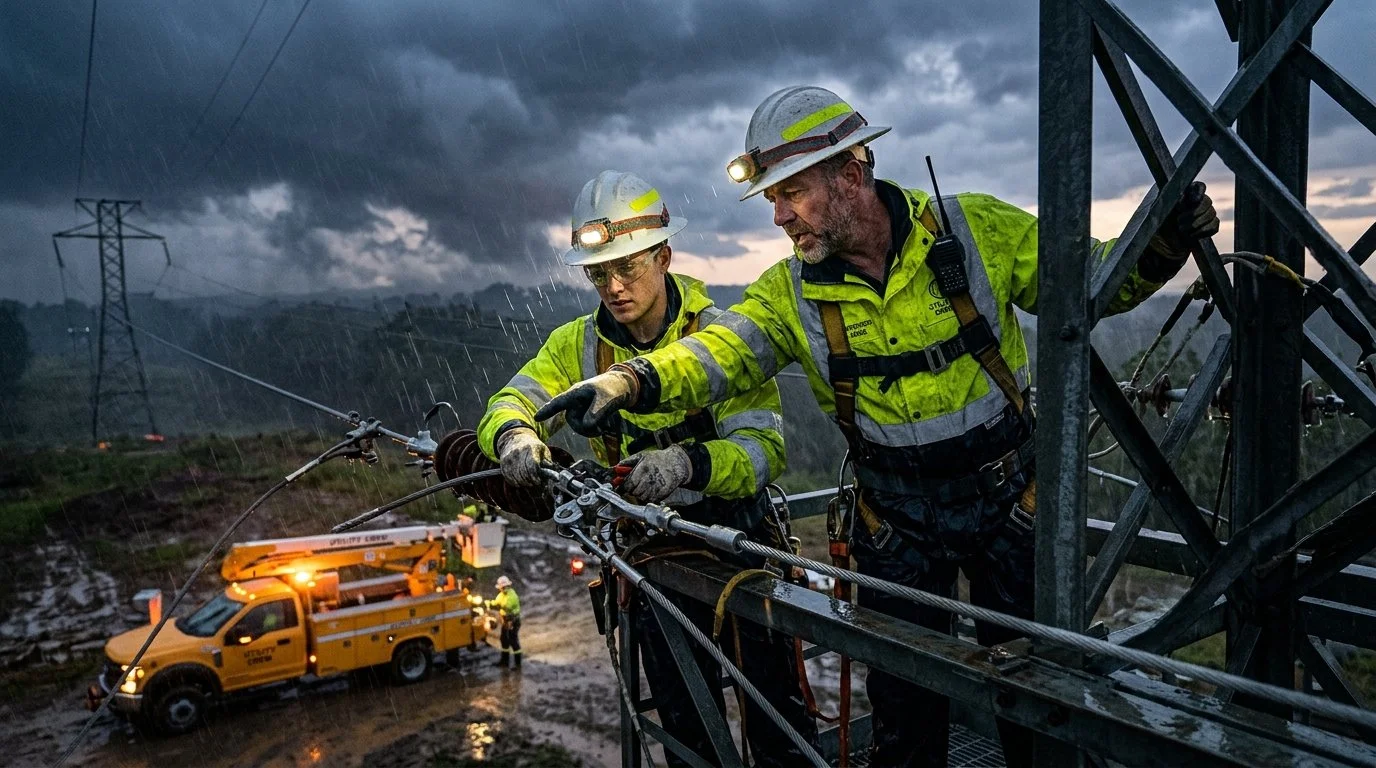
Built for the Utility Industry. Built for the Real World.
Introduction
Most people never think about the people behind the power.
They flip a switch, charge a phone, turn on heat, or run equipment without ever thinking about the crews working behind the scenes to make it happen.
But every light that comes on, every hospital that stays operational, every emergency response system that works during a storm depends on utility workers making critical decisions under pressure.
That responsibility carries weight.
Line work has never been just another job.
It demands skill, sacrifice, adaptability, and the ability to make high consequence decisions in environments most people will never fully understand.
Storms. Fatigue. Emergencies. High voltage. Public pressure. Time pressure. Human error exposure. Constant risk.
And despite all the advancements in equipment and technology, one truth remains:
The biggest factor in safety and performance is still people.
Not policies.
Not slogans.
Not compliance checklists.
People.
That’s why the future of the utility industry depends on leadership development, workforce culture, communication, and understanding human performance at a deeper level.
Why does the utility industry face most pressure than ever?
Why the Industry Is Facing a Critical Shift
The utility industry is going through one of the biggest transitions it’s ever seen. Experienced workers are retiring at a rapid pace. Institutional knowledge is leaving faster than many organizations can replace it.
At the same time, companies are facing:
• Aging infrastructure
• Increased system demand
• Extreme weather events
• Wildfire risk
• Workforce shortages
• Mental fatigue and burnout
• Higher operational pressure
• Rapid technology changes
• Increased public expectations
Crews today are being asked to do more with less margin for error.
And while technical skills remain critical, technical skills alone are no longer enough.
Organizations that want long-term success must understand something many industries are still struggling with:
Human beings are not machines.
The Science Behind Human Performance
Even highly skilled workers make mistakes.
Not because they don’t care.
Not because they’re weak.
Not because they’re careless.
Because human performance is affected by stress, fatigue, pressure, distraction, overload, complacency, and cognitive strain. Science has shown that under pressure, the brain begins narrowing focus, reducing processing ability, and increasing the likelihood of error.
In utility work, those errors can carry life changing consequences. That’s why modern safety leadership can’t be built around blame.
Organizations that only focus on punishment create silence, fear, and hidden risk. But organizations that focus on learning, communication, accountability, and psychological safety create crews more willing to speak up before incidents happen.
That’s where real safety culture begins.
What Safety Culture Actually Means
Safety culture is not posters on a wall. It’s not what gets said during a meeting. It’s what happens when pressure shows up.
Real safety culture shows up when:
• A worker feels safe stopping a job
• A foreman listens instead of reacting emotionally
• A crew member admits a mistake before it becomes catastrophic
• Leadership prioritizes long term safety over short term production
• Workers trust each other enough to communicate honestly
• Accountability exists without humiliation
Culture is built through repeated behaviors over time. Crews don’t learn culture from mission statements. They learn it from leadership behavior.
Leadership Sets the Standard
In utility work, crews can tell immediately whether leadership understands the field or not. You can’t fake credibility in this industry. Workers respect leaders who communicate clearly, stay composed under pressure, take ownership, and genuinely care about the people around them.
The strongest leaders understand that leadership is not about authority. It’s about influence. And influence is built through trust.
Strong leadership improves:
• Communication
• Accountability
• Decision making
• Team cohesion
• Morale
• Adaptability
• Operational consistency
• Psychological safety
Poor leadership creates confusion, frustration, disengagement, and eventually increased exposure to risk.
Many organizations promote highly skilled workers into leadership positions without ever teaching them how to lead people. But leadership is a separate skillset.
A great journeyman may suddenly find themselves responsible for:
• Crew dynamics
• Conflict management
• Emotional regulation
• Stress management
• Coaching apprentices
• Operational planning
• Communication with management
• Decision making under pressure
Without leadership development, many struggle silently. And when leadership struggles, crews feel it immediately.
Why Traditional Training Often Falls Short
One of the biggest disconnects in modern workforce development is that too much training lacks realism. Workers don’t connect with generic corporate presentations that fail to reflect field conditions. Adults learn best when training feels relevant, practical, and emotionally connected to real experience.
Research consistently shows people retain information better through:
• Scenario based learning
• Hands on application
• Storytelling
• Repetition
• Emotional connection
• Real world examples
• Group discussion
• Practical coaching
That’s why workforce development in the utility industry must move beyond information delivery and focus on behavioral development. Because knowledge alone does not always change behavior. Environment does.
The Importance of Psychological Safety
One of the most misunderstood concepts in high-risk industries is psychological safety. Psychological safety does not mean lowering standards. It means creating an environment where workers feel safe speaking up about concerns, mistakes, fatigue, uncertainty, or hazards without fear of humiliation or retaliation.
Studies from high reliability organizations have repeatedly shown that crews communicate more effectively and perform more safely when psychological safety exists.
When workers stay silent, risk grows. When communication improves, exposure decreases. The strongest crews are not the crews pretending to be perfect. They are the crews willing to communicate honestly.
Developing the Next Generation
The next generation entering this industry faces enormous pressure.
Many new workers enter environments where expectations are high, information is overwhelming, and confidence takes time to build. Strong onboarding and mentorship matter. Young workers need more than technical instruction. They need guidance, leadership, coaching, emotional intelligence, and support in learning how to operate under pressure.
The best organizations intentionally develop:
• Confidence
• Situational awareness
• Communication skills
• Decision making ability
• Accountability
• Operational thinking
• Emotional resilience
Because the future of the industry depends on what today’s leaders are willing to build.
Emergency Response & Decision Making Under Pressure
Utility organizations regularly operate in crisis environments. Storm restoration. Wildfires. System failures. Emergency response. During high stress events, communication and leadership become even more critical.
Under stress, people naturally experience cognitive overload. That’s why strong organizations train communication systems before emergencies happen. One powerful concept used in high reliability environments is Commander’s Intent.
Commander’s Intent ensures crews understand the overall objective even when every detail cannot be communicated in rapidly changing situations. This creates adaptability while maintaining alignment. The ability to think, adapt, and communicate under pressure is one of the most important skills any crew can develop.
Building a Sustainable Future
The utility industry does not need more surface level compliance. It needs stronger cultures. It needs emotionally intelligent leadership. It needs organizations willing to invest in people, not just productivity.
Long term safety and operational excellence happen when organizations commit to:
• Leadership development
• Human performance understanding
• Workforce mentorship
• Communication improvement
• Psychological safety
• Accountability with dignity
• Continuous learning
• Trust based cultures
This work is not accomplished overnight.
Culture is built one conversation, one decision, one interaction, and one leader at a time.
Conclusion
The utility industry will always involve risk. But the way organizations lead people determines whether that risk is managed proactively or reacted to after failure occurs. Behind every outage restoration, emergency response, and successful operation are human beings carrying enormous responsibility.
Strong crews are not built through fear. They are built through trust, communication, accountability, leadership, and shared purpose.
Organizations that understand human performance, invest in leadership, and intentionally build culture will not only create safer teams, they’ll also build stronger futures for the next generation of the utility industry.
