

The Hidden Factors Behind Workplace Decisions: How the Human Brain Shapes Safety
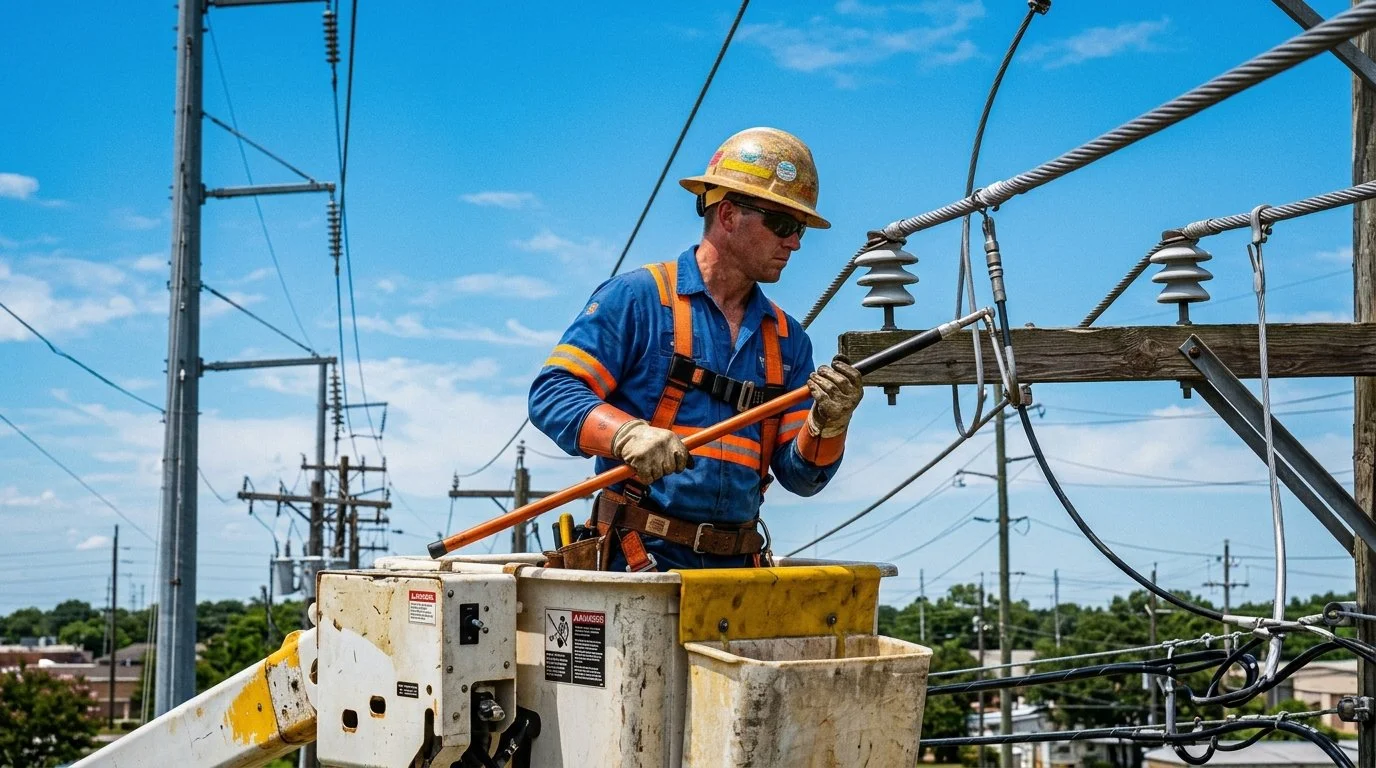
It was a blue-sky day. Sunny, clear, light wind, the coffee still warm in the truck. The kind of morning where the work feels easy and your guard drops without you ever realizing.
Dale had twenty-two years in as a Journeyman. The guy the younger hands looked up to because he made hard work look slow and easy. He'd installed more cutouts than he could count, hung more transformers than he could remember, worked 12 kV hot more times than anybody had ever bothered to track. He could've done most of it with his eyes closed, and on some level, that morning, he was.
The job was nothing. A single-phase tap, one connection. Last job before lunch. Marcus was on the ground, eight months into the trade, still learning where everything lived on the truck, still a little nervous every time the boom went up.
Dale gloved and sleeved up and went to work. The cover was good. But the second phase ran about two feetoffhis shoulder, bare. He didn't rubber it up. Why would he? He wasn't going to touch that one. He was only working this one.
Marcus saw the gap. Something in the back of his mind said that's close. He thought about saying something. Then he thought about who he was, eight months green, and who Dale was, a legend, and he let it go.
Dale leaned in to squeeze the connector. Twisted in the bucket the way you do to get the angle right. And the uncovered part of his upper arm, above the sleeve, found the second phase.
He never got to finish the sentence he was in the middle of.
Every lineman reading this already knows a version of this story. Different name, different voltage, different town. The details change. The shape never does. A good hand, an experienced hand, a careful hand, doing a routine job, on a normal day and then he's gone, or burned, or living the rest of his life one-handed.
The easy thing is to say he got complacent. Shake your head. Say he knew better. And then go back to work.
But "he knew better" doesn't explain anything. Dale absolutely knew better. He could’ve recited the cover-up rule to a roomful of apprentices. He'd enforced it on
other people. So, if knowing better isn't enough, and clearly it isn't, because the brothers and sisters dying out there aren’t the ones who don't know, then we must ask a harder question.
Not what did he do wrong. But what was influencing his decisions.
Because that's where the real story is.
Your brain runs on autopilot, and that's mostly a good thing
The human brain is built tofindpatterns and run them automatically. The first time you do something, climb a pole, hang a transformer, throw a cutout door, your brain works hard. It pays attention to every step. It burns a lot of energy.
Do that same task a hundred times and your brain does something smart; it stops thinking about it. It files the whole sequence as a single automatic routine, like a song you can sing without reading the words. That's how a journeyman makes a complicated task look effortless. The skill is real. The smoothness you see is the brain saying I've got this, I don't need to watch every move and being right, almost every time.
This automatic system isn’t a flaw. It's the reason you got good. Nobody wants a lineman who needs to consciously think through every single motion forty years into the job. You'd never get anything done.
The danger is narrow and specific: autopilot keeps running the old pattern even when the situation has quietly changed.
The job looks the same. So, the brain runs the same routine. But the second phase is closer than usual. Or the configuration is a little different. Or it's a different truck, a different angle, a different set-up. The pattern in Dale's head was built on a thousand jobs, where reaching for to make the connection was fine. His brain wasn't lying to him. It was just running yesterday's map on today's road.
"Nothing's ever happened" is not a safety record
This is the trap underneath the trap. We call it familiarity bias, and it's one of the most dangerous things in this trade because it disguises itself as experience.
Here's how it sounds in your own head;“I've done this a thousand times, and nothing's ever happened.” “This is normal. This is how we always do it.”
Every one of those statements is true. And together they form a conclusion that’s false; therefore, it's safe.
Past success doesn't make a thing safe. It just means the hazard hasn't found you yet. Dale skipped that cover-up hundreds of times and walked away hundreds of times. Every one of those clean jobs didn't prove the shortcut was safe, it just quietly raised his confidence that it was. The brain counts good outcomes as evidence. It doesn't know the difference between "I was safe" and "I got away with it." From the inside, they feel identical.
That's the cruel part. The more experience you have, the more certain your brain becomes about a routine, which means the most experienced hands carry the strongest version of this bias. The hazard didn't grow. The confidence did.
Experience is supposed to make you more aware, not less. The lineman you want to be is the one who's done it a thousand times and still treats the thousand-and-first like it could get them, because they know it can.
Why the new guy stays quiet
Now, back to Marcus on the ground. He saw the uncovered phase. His gut told him it was close. And he said nothing.
That's not weakness, and it's not a characterflawin Marcus. It's authority bias, and it's wired into all of us. We give extra trust to the person with more experience, more rank, and reputation. Usually that's smart, the journeyman does know more than the apprentice.
But it tips into something dangerous when it becomes; he's been doing this longer than me, so he must see something I don't. Who am I to question him?
The honest answer is; you're the guy with a clear view of the gap. That's who you are. Experience doesn’t give anybody immunity. The most experienced person on the crew can be deep in autopilot precisely because he's experienced, running the old pattern, blind to the one thing that changed. And the green hand standing on the ground, not yet smoothed into the routine, is sometimes the only person looking at the hazard with fresh eyes.
A crew where the apprentice can say "hey, that second phase isn't covered" and the journeyman says "thank you, good catch" instead of "shut up, I know", that crew catches things. Speaking up isn't disrespect. It isn't questioning a person’s skill. It's a safety action, same as putting on your gloves. The cost of saying something is a few seconds of feeling awkward. The cost of swallowing it can be a funeral.
If you're the seasoned hand, understand this; the people under you are doing this math every single time. Whether they speak up is mostly decided by you, by how you reacted the last ten times somebody questioned you. You’re training them to speak up or training them to shut up, and you're doing it whether you mean to or not.
The clock, the tunnel, and the tired brain
Three more things were sitting on Dale's shoulders that morning, and they're sitting on yours right now.
Pressure. It was the last job before lunch. That's a small thing and a huge thing. Under any kind of time pressure, beat the weather, beat the clock, get this last one knocked out, the brain narrows. It locks onto the immediate problem and shrinks the field of view. This is tunnel vision, and it's a survival feature, not a bug; when there's an urgent problem, your brain throws everything at it. But the urgent problem is rarely the only problem. Dale was locked onto squeezing that connector. The bare phaseoffhis shoulder wasn't part of the problem he was solving, so his brain edited it out of the picture.
Fatigue. It doesn't just make your body tired. It changes how your brain works. A tired brain reacts slower, remembers less, processes fewer things at once, and most importantly, it leans harder on autopilot, because thinking from scratch costs energy the brain doesn't want to spend. A fatigued person isn't choosing to skip steps. Their brain is quietly conserving fuel by running the automatic routine and trusting it more than it should.
Overload. When too much information hits at once, radio chatter, a question from the ground, the task fighting you, the next job already on your mind, the brain must choose what gets attention. Something always gets dropped. It's not a choice. There's only so much bandwidth. To pick something up, you must put something down.
None of this was a decision Dale made. That's the whole point. He didn't decide to be in a hurry, didn't decide to be running on a pattern, didn't decide to drop the second phase from his attention. His brain did all that underneath him, the way it's built to.
Stop blaming the people. Start reading the conditions.
This is the shift that the best safety programs in our industry are making, and it goes by the name Human Performance. It isn’t soft. It isn’t about excuses. It's the opposite, it's about being honest enough to fix what actually causes these events instead of feeling better by blaming.
The old way looks at Dale and says: he failed to follow procedure. Case closed. Write him up if he'd lived. And then the exact same thing happens to another good hand six months later, because nothing changed.
Human Performance looks at the same event and asks different questions:
What did they actually have in front of him? What conditions were set up around him? What pressures were on the crew? Was there anything that made the safe way the harder way? Did the people around him feel free to speak? What would've had to be true for this not to happen?
People are going to be tired sometimes. Distracted sometimes. Rushed, stressed, running on a familiar pattern, sometimes. That's not failing. That's just being human. You can’t train a person into never having anoffmoment, and any safety system that depends on perfect people is a system that's already failed and just doesn't know it yet.
The goal isn't perfect people. The goal is a system, a crew, and a set of habits strong enough that when a good person has a bad moment, and they will, the hazard still gets caught before it finds them.
The tool that breaks the autopilot
So, how do you catch the thing your own brain is hiding from you? You can't just decide to be more careful. Careful was already there. Dale was careful. Willpower doesn't beat autopilot, because autopilot doesn't ask permission.
What beats it is a structured stop, a forced moment where you step outside the routine and look at the job the way your brain isn't looking at it on its own. That's exactly what a tool like the Energy Wheel is for.
The Energy Wheel doesn't ask you to be smarter or more disciplined than you already are. It just walks you, out loud, through every source of energy that can harm you, electrical, gravity, motion, pressure, mechanical, and the rest, and makes you put a name to each one and ask three plain questions:
What energy is present here? Where could it cause harm? What's controlling it?
Run that on Dale's job and watch what happens. Electrical energy present? Yes, multiple phases, all hot. Not just the one he's working. Where could it cause harm? The bare phaseoffhis shoulder, right in his work zone. What's the control? Cover-up. And there isn't any on that second phase. The gap that his autopilot edited out of the picture is now sitting in the middle of the conversation, named out loud, impossible to skip past.
That's the whole value. The tool doesn't rely on memory or willpower or mood, which are the exact things that fail you when you're tired and rushed and twenty- two years deep into a pattern. It builds a checkpoint into the work where the autopilot has to stop, and the hazard has to be said.
And it gives the crew a shared language. When Dale and Marcus both walk the same wheel, Marcus doesn't have tofindthe courage to challenge a legend. He just has to answer the question on the wheel: is that phase controlled? No. There it is. The tool gave him permission the hierarchy took away.
What we're actually after
We’re never going to build a workplace where linemen don't make mistakes. Anybody who promises you that is selling something. The brain that makes us skilled is the same brain that runs old patterns, trusts past success, narrows under pressure, and conserves energy. You don't get one without the other. That's not a problem to be solved. It's the equipment we showed up with.
What we can build is a trade where those limits are understood and built around instead of pretended away. Where the seasoned hand knows their own autopilot well enough to respect it. Where the apprentice knows their eyes are worth something and their crew has proven they'll listen. Where the tools do the remembering that tired brains can't. Where "we've always done it this way" is treated as a warning, not a reassurance.
Dale knew better. That wasn’t the problem. The problem is that knowing better lives in the part of the brain that goes quiet on a blue-sky day, on the last job before lunch, on the thousand-and-first time.
Understanding how the brain actually works, yours, your journeyman's, your apprentice's, isn't a soft skill or a flashy phrase. It's the difference between a crew that gets away with it and a crew that goes home safe. Every time.
