

The Human Performance Approach to Safety: Why Good Workers Still Miss Hazards
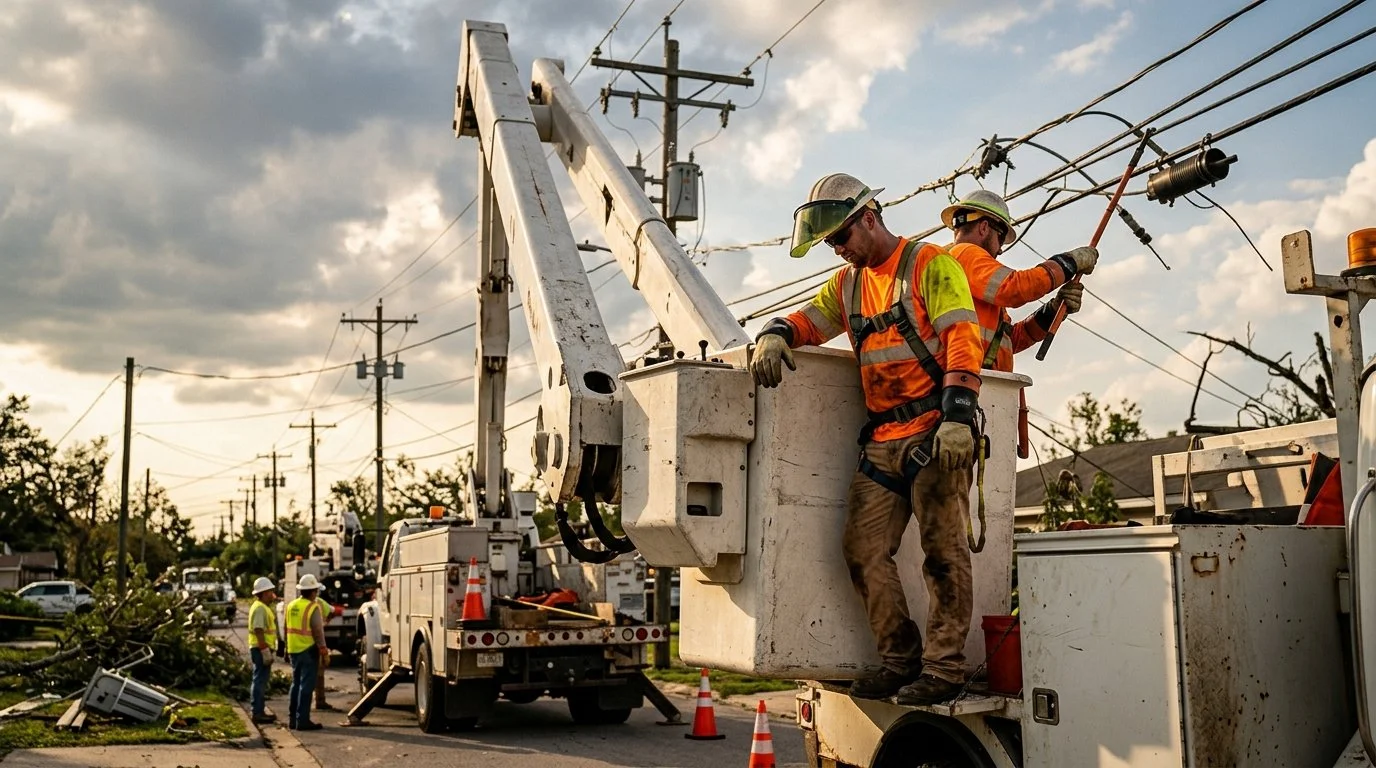
By day four, Ray wasn't really thinking anymore. He was running.
The storm came through the Tuesday before, a wall of wind that snapped poles for 60 miles and put a quarter-million people in the dark. Ray's crew rolled in on mutual aid, 800 miles from home, into a system none of them had ever seen, working off maps that didn't quite match what was in the air. 16-hour days. Six hours of bad motel sleep. 96-degrees and not a cloud, the kind of heat that beats down on you. They'd been re-energizing neighborhoods since sunup, one line after another, all of them dead when they arrived, all of them coming back to life when they closed the fuse.
This one was a service and a span of primary down, on a rural residential road. The switching had been done upstream. The cutout was open and tagged. The section Ray was about to work had been confirmed clear, and Ray's brain, what was left of it on day four, closed the file on it. Dead. We opened it. Get to work.
He went up in the bucket to handle the primary. He had his other hand braced on the phone messenger. He hadn't tested it at the pole yet. He hadn't set his grounds yet. He knew the rule, test before you touch, treat it as hot until it's grounded, and on a normal day he'd have told you that himself, sharp, like it was obvious. But his brain had already filed this line under dead, and the part of him that double-checks was running on empty.
Three houses down, a homeowner had a portable generator running outside his garage to keep his freezer cold. He'd backfed his own panel, no transfer switch, main never opened, and that generator was pushing power back through the service, into the transformer, where it stepped right back up to primary voltage and energized the line Ray had filed away as dead.
There was no way for Ray to see it. No way to feel it. Everything he knew said the line was safe.
He reached for the conductor, and the backfeed found a path across him, primary in one hand, grounded messenger in the other.
Ray lived. A lot of people in that exact spot don't. He spent six weeks in a burn unit and came home without his left hand and with a right arm that doesn't fully work. He'll tell you he was lucky, and he means it.
Here's the part that should make you cringe; the incident report blamed Ray.
"Failed to test and ground the line before contact." And Ray agrees with it. He'll tell you straight that he should’ve tested, he knew to test, that testing’s the most basic thing there is.
And that’s exactly why blaming Ray solves nothing.
If the man who knows the rule, believes in the rule, enforces the rule on his own crew, and would put it at the top of any list you asked him to write, if that man can end up reaching for a hot line with no test and no grounds, then "he should have tested" isn’t an explanation. It's just a description of what didn't happen. It doesn't tell you why. And if you don't know why, you can't stop it from happening to the next guy, who also knows the rule.
For a long time, that's where safety stopped. Find the person, name the error, write the corrective action: re-train on testing procedures. Close the case. And then six months later somebody else gets hit the same way, and everyone's confused, because he was trained too.
The Human Performance approach asks a different question. Not who failed. But what was happening around this person that made the failure likely? Because workers don't operate in a vacuum. Every decision a person makes is shaped by their workload, stress, fatigue, the communication around them, their experience, and the biological limits of the brain they’re carrying up the pole. Most serious mistakes in this trade aren't made by bad hands. They're made by good hands running into the predictable limits of being human, limits that the conditions on day four had stacked against Ray one on top of another.
Let's take them one at a time, because every one of them was in that bucket with him.
Your brain has two gears, and it picks the cheap one
The brain runs on two systems and understanding them is the point of this whole conversation.
The first is conscious thinking. It's the deliberate, careful mode, the one that analyzes a new situation, spots a hazard that wasn't there yesterday, works a problem it hasn't seen before. It's powerful, and it's expensive. It burns a lot of energy, and your brain knows it.
The second is automatic thinking, autopilot. It's built out of repetition. Do a thing enough times and your brain stops running it through the expensive conscious system and starts running it as a finished pattern, no thinking required. That's how a journeyman makes a hard job look easy. The skill is real.
The trouble is that the brain is lazy. It would much rather run the automatic pattern thanfireup the expensive conscious one, and it'll default to autopilot every chance it gets, especially when it's fatigued, because that's when conscious thinking feels most expensive.
Ray had repaired and re-energized dozens of dead sections that week. Open it upstream, confirm it, work it, close it back up. Dead, every time. By the fourth day that whole sequence had hardened into one automatic pattern, and the pattern said this sections dead. Handling the conductor without testing wasn't a decision Ray consciously made. His autopilot had already decided and his conscious mind, the part that would’ve said wait, test it first, never got switched on, because his brain was doing everything it could to avoid the cost of switching it on.
The autopilot wasn't wrong to exist. It was wrong about one thing; it assumed the situation was the same as the last fifty, and this time it wasn't.
"It's on the ground, it’s dead" is a dangerous sentence
This is familiarity bias, and storm work is where it's most lethal, because storm work is repetition at high speed under pressure.
When you do the same task over and over without a problem, your brain builds a hard expectation; this is normal, this is safe. And it counts every clean job as more proof. But a clean job doesn't prove the line was dead. It proves the line was dead that time. The brain can't tell the difference between "this is reliably safe" and "this has happened to be safe so far," and after 30 dead sections in four days, Ray's brain had a mountain of evidence telling him this one was dead too.
Every piece of that evidence was true. The conclusion it built was false. The line was different this time, in a way no amount of experience could see, because the difference was sitting in a stranger's garage three houses away.
That's the thing about familiarity bias; it grows strongest right where you'd want it weakest, in your most experienced, most repeated tasks. The hazard didn't get smaller across those 30 other jobs. Ray's certainty got bigger.
Stress narrows the world down to one thing
There was real pressure on that road. People in the dark, in a heat wave, with food spoiling and medical equipment going quiet. Everybody wanted the lights back, and the crews felt it.
Stress is useful in short bursts, it dumps hormones that let you react fast when something's coming at you. But sustained pressure does something else to the brain: it narrows it. Tunnel vision. The mind locks hard onto the immediate task and quietly drops everything around the edges. Ray was locked onto getting this section back, getting these houses lit, moving to the next. The careful, slow, expensive step of testing a line he was sure was dead lived out at the edge of his attention, in exactly the part of the picture that stress had already cropped out.
Fatigue isn't tiredness. It's a different brain.
Day four. Minimal sleep. We talk about fatigue like it's just feeling worn out, but that misses what's actually happening. A fatigued brain is a measurably different brain. Slower reactions. Weaker memory. Less ability to hold several things in mind at once. And this is the dangerous one, it leans even harder into autopilot, because conscious thinking is the most expensive use of the bodies energy and the tired brain is desperate to conserve energy.
A tired lineman doesn’t decide they don't care about safety. Ray cared about safety more than almost anything; it's most of who he is. His brain just kept steering toward the cheapest available option, automatically, underneath his awareness. By day four, the gap between the rule he believed in and the action his brain took had been pried wide open by exhaustion, and he never felt it happening. Nobody does. That's what fatigue is.
The part nobody counts; he hadn't hydrated in hours
Here's a factor that gets leftoffalmost every incident report, and it was sitting right there in the bucket with Ray. He hadn't taken a drink of water in hours. Ninety-six degrees, full FR clothing, climbing and sweating, and water was one more thing his narrowed, overloaded brain had droppedoffthe list.
The brain runs on hydration the same way it runs on sleep. Even mild dehydration measurably degrades concentration, reaction time, communication, and decision- making, and you don't feel it as "I'm impaired." You feel fine, right up until you make a call you'd never normally make. A few percent down on fluids and a person's judgment quietly drops a notch, and they had no idea it happened. On a long, hot storm shift, dehydration isn't a comfort issue. It's a cognitive one. It was part of why the most basic discipline in the trade slipped past a man who knew it by heart.
Cognitive overload; looking right at it and not seeing it
Now stack everything Ray's brain was trying to hold at once. An unfamiliar system. Maps that didn't match the field. Mutual-aid crews he'd never worked with, scattered across circuits he didn't know. Which sections were open, which were tagged, which were clear, who was where. The brain has a hard ceiling on how much it can actively track, and when too much arrives at once, it starts triaging, pushing things into the background to make room.
This is how a skilled lineman can look straight at a hazard and not register it. The information was available. Their attention was already spent. When the brain is overloaded, it doesn't carefully choose what to drop, it just drops, and "test this line before you touch it" went into the background.
"Human error" is where the thinking stops, not where it should start
Look at what was actually loaded onto Ray that morning; an autopilot built from 30 safe jobs, a familiarity bias that grew with every one of them, stress narrowing his focus, four days of fatigue pushing him toward the cheap automatic path, dehydration quietly degrading his judgment, and an overloaded brain triaging away the one step that would have saved his hand. Then add a hazard he physically couldn’t see or feel.
"Failed to test before contact" describes none of that. It's the last link in a long chain, and pointing at it feels like an answer while explaining nothing. Worse, it aims thefixin the wrong direction, at telling people to be more careful, when the people getting hurt are already careful and already know better. You can’t retrain your way out of the limits of the human brain. Those limits are standard equipment.
A stronger approach builds systems that hold the line when a good person's attention is shot, when they’re on day four, dehydrated, overloaded, and running on a pattern. The question stops being how do we get people to stop being human and becomes how do we design the work so that a tired, stressed, overloaded human still goes home.
A tool that works when the brain doesn't
This is where something like the Energy Wheel earns its place, not as another form tofillout, but as an external brain for the moments your own brain is running on fumes.
The whole point is that it doesn't rely on the things that fail you under fatigue and pressure; memory, attention, judgment, willpower. It's a structure outside your head that forces the question your autopilot has already answered wrong. It walks you through the energy sources in front of you and makes you name each one out loud and account for it before work starts.
Run it on Ray's job. Electrical energy present? The honest answer the wheel forces isn't "no, we opened it upstream." It's "treat it as present until it's tested and grounded right here, at this pole." That single forced step doesn't care that Ray was sure. It doesn't care that the last 30 were dead. It puts the test back in front of him as a thing that must happen, not a thing his exhausted autopilot already skipped. The backfeed he couldn't see gets caught not by Ray being sharper, he had nothing left, but by a structure that does the remembering a fried brain can't.
And it gives the whole crew one language. The newest hand and the salty journeyman walk the same wheel and ask the same questions, so the catch doesn't depend on any one person being at their best at the worst possible moment.
What a real safety culture is actually for
You’ll never build a workforce of people who don't get tired, stressed, dehydrated, and overloaded. Storm work guarantees all four. Any safety program that quietly depends on people staying perfect on day one let alone day four is a program that's already failed and is just waiting to find out.
A real safety culture isn't built on the expectation that people won't reach their limits. It's built knowing they will, and designing the work, the tools, and the crew so that when a good hand hits the wall, the hazard still gets caught before it catches them.
Ray will tell you he should have tested. He's right, and it's the least useful true thing anyone could say about that morning. The useful question isn't what Ray did wrong. It's what we put on him before he ever went up and what we could have built around him that would’ve caught the one invisible thing his worn-out brain couldn’t.
Everybody knew that line was dead. That was the whole problem.
